When police arrest the wrong person, or charges are dropped or never filed, the arrest record should clear itself. No forms. No fees. No waiting. That is the #AutoErase™ idea.
Being released is not the same as being cleared. An arrest record can follow an innocent person into every background check.
Tap a state.
Watch it spread: each state takes its color in the year the law that puts it in its group was enacted. Laws older than 2007 show from the start. Pick a group above (Auto, Agency-started, On request, Judge decides) to watch only that group. The star marks laws from #AutoErase work.
See your state representative and state senator, then email or message them the 2027 model legislation in two taps.
In 27 states, arrest records are cleared with nothing to file when charges are dropped or never filed, the case ends in not guilty, or the arrest was a case of mistaken identity. Cleared can mean erased, sealed or hidden from public view. What each law covers varies by state. Not all 27 laws came from #AutoErase. This map is general information, not legal advice.
Three quick questions. General information, not legal advice.
Where your record may be kept, how to get a copy, and how to ask to have it cleared, state by state. General information, not legal advice.
Searches court and arrest records nationwide. You can only search yourself; the company checks your identity. It is not an official copy: for that, use the steps below.
An arrest can be kept in four places. Check each one: clearing it in one place does not always clear it in the others.
Background-check companies must give you a copy of what they report about you, free if you were turned down because of their report in the last 60 days. The rejection notice has to name the company.
Legal aid lawyers and record-clearing clinics can look at your case and fill out the forms with you.
We'll email you at 30, 60 and 90 days to ask whether you heard back, with the next step. One click to stop.
We use your email only for these reminders.
Founder Charles Belk has worked with lawmakers across the country. Seven states have passed laws from his #AutoErase work, with these champions.
The first state to sign an #AutoErase law, at a governor's ceremony in Raleigh.
The first state to file an #AutoErase bill (January 2015).
The agency must ask the court to expunge a mistaken-identity arrest, at no cost.
Seal records within 60 days of finding an arrest wrongful, and notify the person.
Mandatory expungement for mistaken-identity arrests. Charles testified in person.
Carried forward through the NBCSL resolution on #AutoErase.
Eleven years after Rep. John King's first bill. Enacted over a veto.
Three ways in. Each one takes a few minutes.
Bring the 2027 #AutoErase Model Legislation to your chamber. It is free to copy and adapt.
Constituents: tell your own state legislators you want it introduced.
Fund the campaign, and ask your city council or county commission for a proclamation supporting the #AutoErase Model Legislation.
Check your state on the map, ask the arresting agency in writing for your record status, and keep every document you were given at release.

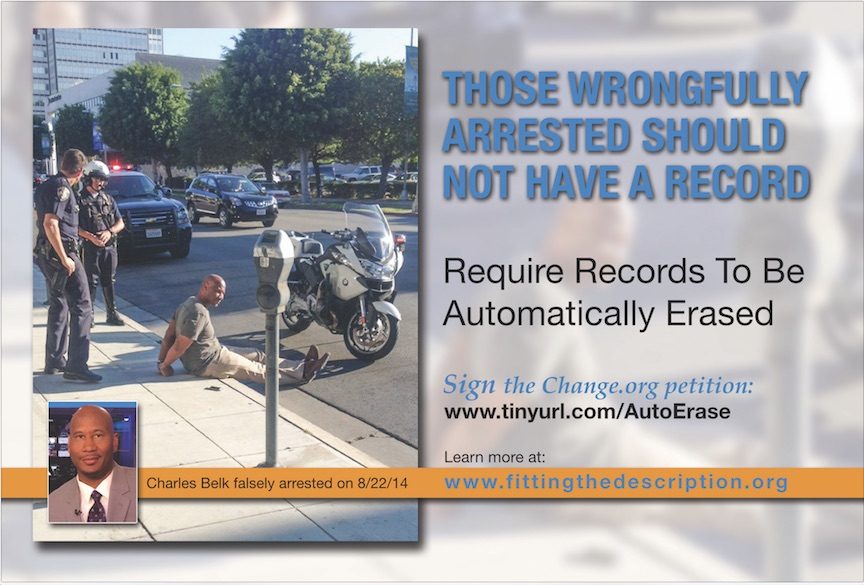
Charles Belk was detained because he "fit the description" of a tall, bald Black man involved in a bank robbery. He was released after video showed he was the wrong man, and then learned the arrest record remained.
He launched #AutoErase that fall. Seven states have since passed laws from that work.
#AutoErase-style bills in current sessions. Checked every week.
Built from the strongest parts of today's state laws, for states with no automatic clearing yet. Bracketed numbers are for each state to set.
Searches the #AutoErase 50-state research, checked updates and this site first. If the answer isn't there, it checks Google and labels that clearly. Every question we can't answer gets researched.
Try:
General information, not legal advice. For your own case, talk to a lawyer or local legal aid.
AutoErase™ tools are free: AI help, grounded in the #AutoErase research, to check your record, ask to clear it and write to your lawmakers. General information, not legal advice.
No stories posted yet. Be the first to share yours (anonymously).
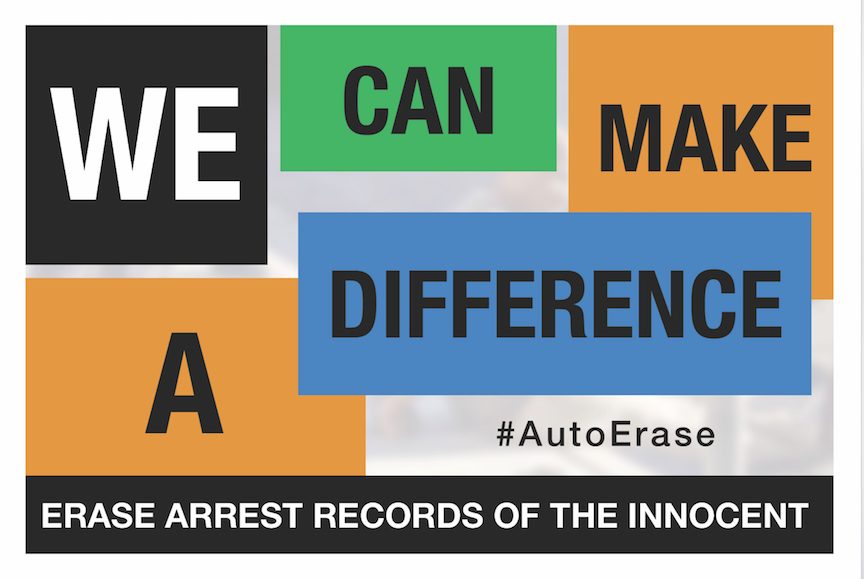
It started with one man on a curb, a Facebook post and a stack of postcards. Here is how #AutoErase got from there to seven state laws.
Charles Belk is handcuffed on a Greater Los Angeles curb because he "fit the description" of a bank robbery suspect. Video shows he is the wrong man. He is released, and learns the arrest record stays.
He starts the #AutoErase petition on Change.org, asking every attorney general to erase the records of people wrongfully arrested.
Washington, D.C.: the Congressional Black Caucus Foundation Annual Legislative Conference (CBC-ALC), with Howard University students handing out cards, meetings on Capitol Hill, and a panel live on C-SPAN. Rep. Ken Dunkin introduces him around, and he runs into Sen. Floyd McKissick Jr., his own state senator.
Puerto Rico: meeting legislators of the National Hispanic Caucus of State Legislators (NHCSL).
Dallas: the National Black Caucus of State Legislators (NBCSL) conference. Charles puts an #AutoErase card on every chair before the session starts.
Illinois files the first #AutoErase bill (HB 169, Rep. Ken Dunkin).
Rhode Island: the House passes Resolution H 5448 honoring Charles Belk, sponsored by Rep. Carlos Tobon, and introduces him on the House floor.
North Carolina signs Sen. McKissick's S 233, the first #AutoErase law.
Illinois signs Rep. Ken Dunkin's HB 169, the second law.
NHCSL (Resolution 2015-09, Nov 21) and NBCSL (Resolution LJE-16-22, ratified Dec 4) back #AutoErase.
Durham, N.C.: Mayor William V. "Bill" Bell proclaims Thursday, March 10, 2016 "Charles Belk and Justified AutoErasure Day." The proclamation is read and presented at the City Council on March 7.
Colorado signs HB16-1265 by Reps. Jovan Melton and Daneya Esgar, the third law.
Rhode Island enacts Rep. Carlos Tobon's H 7094, the fourth law.
Kansas approves mandatory expungement for mistaken-identity arrests (Sen. David Haley; Charles testified in person).
Missouri signs automatic expungement for mistaken-identity dismissals (RSMo 610.145), carried by Rep. Karla May.
South Carolina enacts Act 248 over a veto, eleven years after Rep. John King's first bill.
Before the room filled, Charles walked the rows and left an #AutoErase card on every seat. Captions in English and Spanish.
Approved facts, quotes and interviews with Charles Belk and the #AutoErase campaign.
Charles is based in Johannesburg; recorded interviews and U.S. morning slots work best.
Comments, questions, corrections, or your own story. We read everything.
The form above is the fastest way: it goes straight to the team. For mail, use the address at the bottom of the page.
For press and general matters:
 ™